Videos: 23 min 31s total, reading time – about 7 min = 30 min total

Here we discuss one the most famous theorems in Geometry and Math as a whole.
This very important theorem belongs to a Greek philosopher Pythagoras (the picture here is taken from Wikipedia).
When one of the angles of a triangle is 90 degrees, we call such a triangle ‘right triangle’. The name is easy to remember and sounds natural as the triangle has one right angle.
The other two angles of the right triangle are complementary, which means that their measures add up to 90 degrees.
Let me quote Wiki again:
A right triangle (American English) or right-angled triangle (British English) is a triangle in which one angle is a right angle (that is, a 90-degree angle). The relation between the sides and angles of a right triangle is the basis for trigonometry.
The side opposite the right angle is called the hypotenuse (side c in the figure). The sides adjacent to the right angle are called legs (or catheti, singular: cathetus). Side a may be identified as the side adjacent to angle B and opposed to (or opposite) angle A, while side b is the side adjacent to angle A and opposed to angle B.
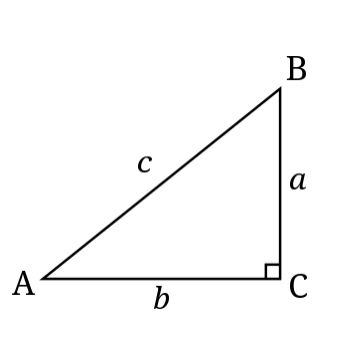
1 Pythagorean theorem
In any right triangle
$$ a^2+b^2=c^2 $$
This great theorem gives us the means to calculate any side of the right triangle when we know the other two sides.
2 Proof
In this video I present a geometrical proof of the theorem. Algebraical proof is also possible.
3 Pythagorean Triples
There are special triangles which help us solve many problems without actually performing calculations.
There are 16 primitive Pythagorean triples with c ≤ 100:
| (3, 4, 5) | (5, 12, 13) | (8, 15, 17) | (7, 24, 25) |
| (20, 21, 29) | (12, 35, 37) | (9, 40, 41) | (28, 45, 53) |
| (11, 60, 61) | (16, 63, 65) | (33, 56, 65) | (48, 55, 73) |
| (13, 84, 85) | (36, 77, 85) | (39, 80, 89) | (65, 72, 97) |
However, it is advisable to memorize only the first line of the table.
The word ‘primitive’ means that all the numbers in each triple are coprime. In other words, there is no common factor. By multiplying each three numbers of any triple by the same factor, we arrive at another Pythagorean triple, which is not primitive.
For example:
(3, 4, 5) => 2x(3, 4, 5)=(6, 8, 10) / 3x(3, 4, 5)=(9, 12, 15) / 4x(3, 4, 5)=(12, 16, 20) /
5x(3, 4, 5)=(15, 20, 25)
and so on.
4 Why are Pythagorean triples worth memorizing
The answer to this question is simple: it saves a lot of time and effort at competitions and exams. Having learned basic Pythagorean triples, you increase your chances to avoid actual calculation via Pythagorean theorem, as I mentioned above.
For example, have a look at this problem (AMC* 2017)

In AMC 8 we have to answer 25 questions in 40 minutes, so we have 1 minute 36 seconds for each question on average. How do Pythagorean triples help here, if there are no right triangles? What helps us is the idea to simplify this problem by using familiar shapes. Here we go: let’s connect D and B by drawing a segment BD.

Thus we have created at least one right triangle BCD. The Pythagorean triple (3, 4, 5) immediately gives us BD=5. This also proves that BDA is a right triangle, because we know (5, 12, 13) to be a Pythagorean triple, too. That information provides us with a very fast way to compute the area of quadrilateral ABCD – watch this video,
or, better, work it out yourself.
*AMC – American Mathematics Competitions
1,888 total views, 4 views today